
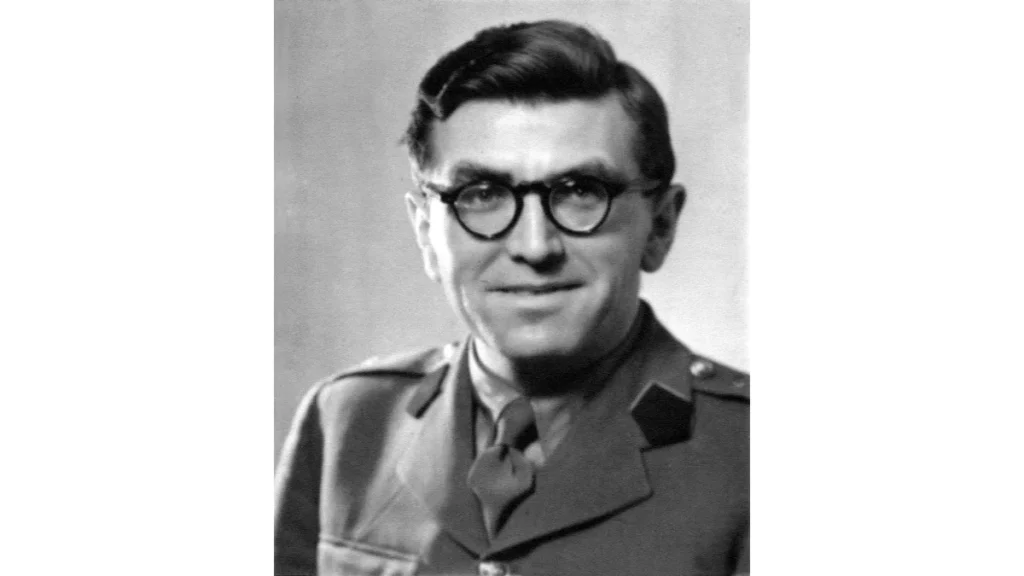
Henryk Zygalski, a Polish mathematician who helped break the Enigma cipher before the Second World War, laying the foundations for Alan Turing’s work at Bletchley Park, has been honoured with a commemorative plaque at the University of Surrey.
After the war, he taught mathematics at Battersea Polytechnic and the University of Surrey for 17 years without his colleagues learning what he had done.
Zygalski was a mathematician at the Polish Cipher Bureau, with Marian Rejewski and Jerzy Różycki, who worked out how to read messages sent on Germany’s Enigma machine in the 1930s. In 1938, he devised the Zygalski sheets – large, perforated cards that, when stacked on a light table, showed codebreakers how the machine had been set up.
In 1939, weeks before Germany invaded Poland to start the Second World War, the Polish team shared everything they knew about Enigma with British and French intelligence. Their work laid the foundations for Alan Turing and his colleagues at Bletchley Park.
The plaque was revealed on Poland’s National Independence Day, by Professor Stephen Jarvis, President and Vice-Chancellor of the University of Surrey, and Rafał Wiśniewski, Chargé d’Affaires ad interim at the Embassy of the Republic of Poland in London.
Members of Zygalski’s family, representatives of the Polish community and historians, including from Bletchley Park, attended.


